Best Honeymoon Cabins United States: An Editorial Evaluation Guide
The concept of the honeymoon has undergone a profound structural shift over the last decade. While the mid-century ideal often centered on the coastal resort or the grand urban hotel, the contemporary newlywed demographic is increasingly gravitating toward “secluded immersion”—a state of being where the physical environment acts as a protective shell for the relationship. In this evolving landscape, the cabin has emerged as the premier architectural vehicle for this immersion. It is no longer viewed as a rustic compromise, but as a highly engineered sanctuary that balances the primal appeal of the wilderness with the sophisticated demands of modern luxury.
Selecting a cabin in the United States requires a departure from surface-level aesthetics. The geographic diversity of the American landmass—ranging from the high-altitude isolation of the Rockies to the humid, verdant corridors of the Blue Ridge Mountains—means that a “cabin” can manifest as anything from a glass-walled cantilevered structure to a hand-hewn log estate. This variety necessitates a rigorous analytical framework for couples. One must evaluate not just the view, but the “service-to-silence” ratio, the logistical resilience of the location, and the psychological impact of the specific biome on the transition from the high-intensity wedding environment to the contemplative state of the honeymoon.
The market in 2026 reflects a “bifurcation of luxury.” On one side is the hyper-amenitized resort cabin, where every need is anticipated by an invisible staff; on the other is the “true-private” estate, where the luxury is found in absolute autonomy and the absence of human interference. For those seeking the best honeymoon cabins united states, the challenge lies in navigating this spectrum. It is an investment in “relational infrastructure”—the creation of a space where the noise of the external world is replaced by the specific frequencies of nature and intimacy. This editorial exploration provides the necessary depth to make that investment with clinical precision and emotional honesty.
Understanding “best honeymoon cabins in the United States.”
To define the best honeymoon cabins united states, one must look past the “cozy” marketing tropes. A premier honeymoon cabin is a managed environment designed to facilitate a specific psychological outcome: the decompression of the individual and the bonding of the couple. In this context, “best” is a measure of the property’s ability to maintain its “intimacy-barrier”—the degree to which it excludes the digital and physical intrusions of the outside world while providing high-fidelity sensory experiences, such as the sound of a specific creek or the visual clarity of a high-altitude night sky.
A multi-perspective view reveals that “the best” is often a function of “negative space.” It is not the presence of a gold-plated faucet that defines a top-tier cabin, but the absence of a neighboring roofline, the lack of light pollution, and the silence of a roadless horizon. There is a common misunderstanding that luxury in a cabin is additive—more amenities, more square footage, more gadgets. However, from an editorial and experiential standpoint, luxury is subtractive. It is the removal of friction. A cabin that requires a couple to spend their first three hours troubleshooting a complex smart-home system has failed its primary mission, regardless of its nightly rate.
There is also a significant oversimplification risk regarding “seclusion.” Many properties advertised as secluded are merely “screened” by a thin layer of vegetation from a high-traffic tourist road. A genuine honeymoon cabin must be evaluated through its “buffer zone”—the actual acreage or geological barriers that separate the porch from the nearest human activity. For the sophisticated traveler, the “best” cabin is often one that acknowledges its own vulnerability to the elements, integrating its design into the landscape rather than attempting to dominate it.
The Historical and Systemic Evolution of the American Cabin
The American cabin began as a unit of survival. In the 17th and 18th centuries, the log structure was the primary architectural tool of the frontier, brought to the New World by Swedish and Finnish settlers. These were utilitarian spaces—16×20 foot rectangles designed for thermal efficiency and rapid construction. The “luxury” of these early cabins was purely binary: you were either inside and safe from the elements or you were not.
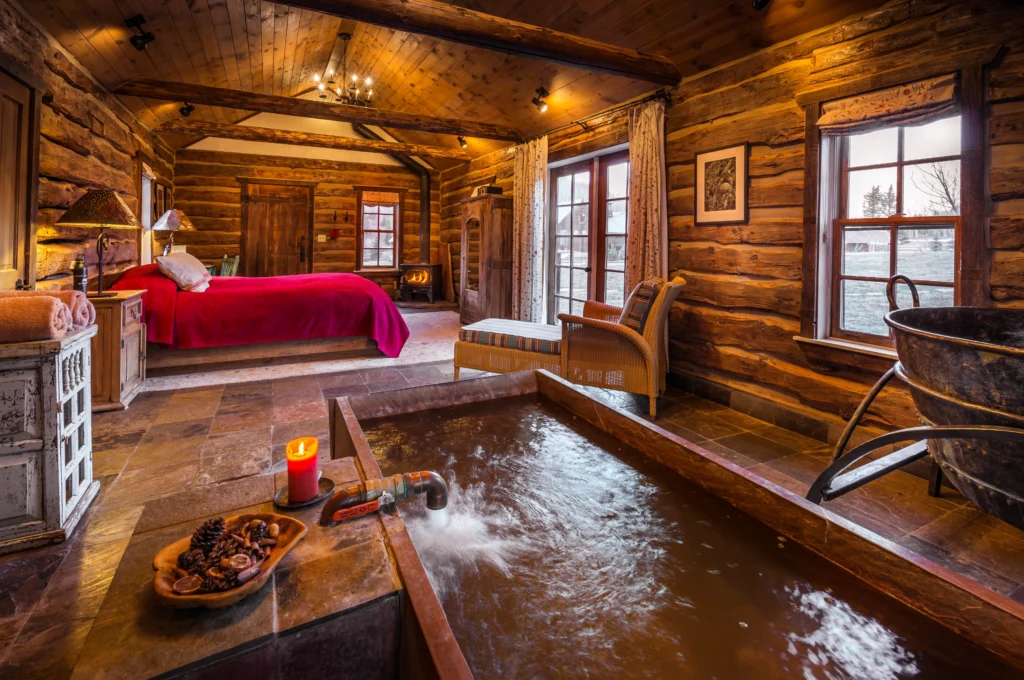
The transition from “survival” to “sanctuary” occurred in the mid-19th century with the “Great Camps” of the Adirondacks. This was the birth of the luxury cabin as a social statement. Industrialists built sprawling timber estates that mimicked the rustic aesthetic but included the comforts of the city—staff quarters, professional kitchens, and imported textiles. This era decoupled the cabin from the labor of the land, turning it into a stage for the “curated wilderness” experience.
The late 20th century saw the democratization of the cabin through the “resortification” of regions like the Great Smoky Mountains and the Ozarks. This created a new systemic reality: the “cabin community.” While these developments increased accessibility, they often sacrificed the very seclusion they promised. Today, in 2026, we are seeing a “post-resort” evolution. The most sought-after cabins are now “architectural objects”—highly designed, often prefabricated, and placed in extreme, hard-to-reach locations using advanced logistics. The modern honeymoon cabin is no longer just a place to stay; it is a technological feat that allows for high-end living in places where, historically, humans could only survive.
Conceptual Frameworks and Mental Models for Selection
To evaluate a honeymoon cabin with editorial rigor, consider these three mental models.
The Thermal-Acoustic Envelope
This model evaluates a cabin by its ability to modulate the sensory environment. A high-quality cabin creates a “micro-climate” of comfort. Can the structure maintain a steady internal temperature without a loud HVAC system that breaks the silence of the woods? Does the roof material enhance or irritate the sound of rain? The “envelope” is the primary interface between the couple and the wilderness; it must be seamless.
The “Friction-to-Feature” Ratio
Every cabin has “friction”—the logistical effort required to reach it, heat it, or feed oneself within it. A top-tier cabin ensures that every unit of friction is rewarded by a “feature” of equal or greater value. If a cabin requires a 4×4 vehicle and a 2-mile hike (high friction), the view or the total silence must be world-class (high feature). A mismatch in this ratio leads to honeymoon fatigue.
The Anthropogenic Buffer Theory
This theory posits that the value of a cabin increases exponentially with every mile of “non-human” space surrounding it. In a country as populated as the United States, space is the ultimate luxury. When searching for the best honeymoon cabins united states, one should measure the distance to the nearest “uncontrolled” human noise (airports, highways, power plants).
Key Categories of Cabin Biomes and Trade-offs
The American landscape offers distinct “cabin biomes,” each with its own set of environmental trade-offs.
| Biome | Geographic Profile | Primary Trade-off | Ideal For |
| Appalachian Verdant | Mist-covered, dense forest, temperate. | High humidity; insect density; localized fog. | Deep intimacy; “cozy” aesthetics; short-haul travel. |
| Rocky Mountain High | Glaciated, alpine, high-altitude. | Thin air; severe weather shifts; UV intensity. | Active couples; dramatic vistas; low humidity. |
| Desert Modernist | Arid, high-contrast, rocky. | Extreme temperature swings; water scarcity. | Architectural enthusiasts, stargazing, stillness. |
| Pacific Northwest Fern | Rainforest-adjacent, mossy, dark. | High rainfall, limited natural light, and dampness. | Intellectual retreats; moody aesthetics; coffee culture. |
| Coastal Boreal | Rugged coast, salt-air, wind-swept. | Structural noise (wind/surf); salt corrosion. | Sound-seekers; high-energy nature; fresh air. |
Decision Logic: If the goal is “recovery” after a stressful wedding, the Appalachian biome offers the most “womb-like” environment. If the goal is “inspiration” and a new beginning, the Rocky Mountain or Desert biomes provide the necessary visual expansion.
Detailed Real-World Scenarios and Decision Logic
Scenario A: The Urban High-Burnout Couple
Based in a city like Chicago or New York, they need absolute silence but are not “outdoorsy.”
-
The Decision: A luxury glasshouse cabin in the Hudson Valley or a “modern-rustic” estate in the Blue Ridge.
-
Logic: They require the “visual” of nature without the “tactile” discomfort. The cabin must have a 5-star kitchen and high-speed satellite internet, even if they intend to ignore it. The luxury here is the option of the world, kept at bay.
Scenario B: The Adventure-Legacy Couple
They view the honeymoon as the “first expedition” of their marriage.
-
The Decision: A fly-in cabin in the Alaskan interior or a high-alpine hut in the Sawtooth Mountains of Idaho.
-
Logic: The “friction” of the travel is part of the bonding process. The cabin is a basecamp for exploration. The failure mode here would be a cabin that is “too comfortable” or too close to a town, which would diminish the sense of shared achievement.
Scenario C: The Aesthetic/Content-Conscious Couple
They value the visual narrative of their honeymoon as much as the experience itself.
-
The Decision: A “Treehouse” luxury cabin in the Pacific Northwest or a “Mirror House” in the Texas Hill Country.
-
Logic: The architecture is the main attraction. The cabin must be “camera-ready” at all angles. The risk is that these cabins often prioritize form over function (e.g., poor insulation or awkward layouts), which can cause friction during a 7-day stay.
Planning, Cost, and Resource Dynamics
The economic structure of a honeymoon cabin is significantly different from that of a hotel. You are often paying for the “opportunity cost” of the land not being developed into more units.
Estimated Resource Allocation Table (2026 Rates)
| Tier | Weekly Rate | Logistics Cost | Hidden Variables |
| Accessible Luxury | $3,500 – $6,000 | Low (Car rental) | Resort fees; cleaning surcharges. |
| Architectural Icon | $8,000 – $15,000 | Moderate (Flight + SUV) | Grocery delivery premiums; fuel for remote heat. |
| Absolute Seclusion | $20,000 – $50,000+ | High (Private Pilot/4×4) | On-site staff; specialized insurance. |
Hidden Costs: Remote cabins often have “resource constraints.” In 2026, many high-end cabins utilize well water and septic systems. A sudden failure in these systems can cost a couple their entire honeymoon “vibe” as they wait 48 hours for a specialized technician to reach a remote zip code.
Tools, Strategies, and Support Systems
-
The “Light Pollution” Map: Use tools like DarkSiteFinder to verify if the cabin actually offers the stargazing promised in the photos.
-
Topographical Verification: Use Google Earth’s 3D view to see if there is a hidden quarry or a major trucking route just over the ridge.
-
Satellite Connectivity Check: For remote work or emergencies, verify if the cabin has Starlink or similar high-altitude satellite arrays. Cellular service is rarely a reliable metric in the mountains.
-
The “Supply Chain” Strategy: For absolute seclusion, utilize a “provisioning service” that stocks the cabin 24 hours before your arrival. The first day of a honeymoon should not be spent in a grocery store line.
-
Private Aviation Charters: For the best honeymoon cabins united states in regions like Montana or Alaska, a private charter (e.g., Wheels Up or local bush pilots) is not a luxury—it is a time-management necessity.
-
Climate-Resilient Packing: In 2026, weather volatility is high. Always pack for “two seasons ahead” of the current forecast. A 70-degree day in the Rockies can become a 20-degree night without warning.
The Risk Landscape: Compounding Failures in Remote Settings
The very thing that makes a cabin attractive—its distance from civilization—is its primary risk factor.
-
The “Service Lag” Effect: If the hot tub or the heating system fails on a Tuesday, and the nearest repairman is 100 miles away and booked until Friday, the “luxury” experience collapses.
-
Ecological Volatility: Wildfire smoke is a significant risk for Western cabins from July to September. A $10,000-a-week cabin is unusable if the Air Quality Index (AQI) exceeds 200.
-
The “Isolation Paradox”: For some couples, total silence can lead to “sensory deprivation anxiety.” The transition from a loud, social wedding to a silent forest can be jarring and may require a “tapering” strategy (e.g., staying in a town for two nights first).
Governance, Maintenance, and Long-Term Adaptation
A honeymoon cabin is a living system. For the duration of the stay, the couple must act as “stewards” of the environment.
-
Resource Management: In high-end cabins, “off-grid” systems (solar, well-water) require active monitoring. Managing one’s “energy footprint” is part of the experience.
-
Review Cycles: Before booking, check the “recency” of reviews. A cabin that was 5-star in 2024 can degrade rapidly by 2026 if the management company has changed or if the local environment has suffered a major storm.
-
The Adaptation Checklist:
-
Verify current wildfire/storm status 48 hours prior.
-
Confirm the “buffer” zone hasn’t been compromised by new construction.
-
Test emergency communication (Sat-phone/InReach) upon arrival.
-
Review the “evacuation protocols” provided by the host.
-
Measurement, Tracking, and Evaluation of the Experience
How do you measure the “ROI” of a honeymoon cabin?
-
The “Heart-Rate Variability” (HRV) Signal: A quantitative measure of physiological recovery. A successful cabin stay should see a 10-20% increase in HRV by day four.
-
The “Conversation Depth” Indicator: A qualitative assessment of whether the environment allowed for “future-state” planning rather than just “transactional” logistics.
-
The “Digital Detox” Ratio: Tracking the number of hours spent off-screen. A “top” cabin makes the screen feel unnecessary and intrusive.
Common Misconceptions and Oversimplifications
-
Myth: “All-inclusive” cabins are better. Fact: You often pay for low-quality food and generic service. A private estate with a “bespoke chef” is a superior investment.
-
Myth: Modern cabins are “bug-free.” Fact: Nature always finds a way. A cabin that is too sterile often feels disconnected from the landscape.
-
Myth: Higher altitude always means better views. Fact: High altitude often means more cloud cover and “whiteouts.” Mid-range elevations often provide better visual depth.
-
Myth: Log cabins are the most “authentic.” Fact: Modern glass-and-steel cabins often provide a more “authentic” connection to the view by removing visual barriers.
-
Myth: You need to go to a “famous” town (e.g., Aspen). Fact: The most secluded, high-value cabins are often in towns you have never heard of.
Ethical and Contextual Considerations
The rise of luxury honeymoon cabins has a significant impact on local rural communities.
-
Overtourism and Housing: Many remote areas are facing housing crises as cabins are converted into short-term rentals. Choosing properties that are part of “managed estates” rather than single-family neighborhoods can mitigate this.
-
Environmental Impact: The “carbon footprint” of flying to a remote cabin and heating it can be significant. Look for cabins with LEED certification or those that utilize geothermal and solar energy.
Conclusion: The Synthesis of Autonomy and Connection
The search for the best honeymoon cabins united states is ultimately a search for a setting that matches the couple’s internal state. It is about finding a physical structure that provides the security of the past and the vision of the future. In 2026, the cabin is the ultimate architectural expression of this balance—a place where one can be both wild and protected, isolated and connected. By applying a rigorous analytical lens to the selection process, the honeymoon ceases to be just a vacation and becomes a foundational memory, built on the solid ground of a well-chosen sanctuary.